
Liquidity Events for Family-Owned and Founder-Led Businesses
Shareholders, succession, and the importance of liquidity planning:

Liquidity events for private companies are not limited to acquisitions or IPOs. They are deliberate ownership diversification decisions that can reduce risk concentration and position family-owned and founder-led businesses for their next phase of growth
Family- and founder-led companies face unique succession and shareholder dynamics, making long-term liquidity planning essential to protect company value and preserve a founder’s legacy
The most successful liquidity outcomes are planned years in advance, with experienced advisors helping owners evaluate pathways, optimize tax efficiency, and align business strategy with long-term personal, family, and financial goals
A Crash Course on Liquidity Events for Family-Owned and Founder-Led Private Companies
For many family-owned business leaders, most of their net worth is tied up in the company. That concentration often reflects years, sometimes generations, of operational discipline, calculated risk-taking, and strategic growth. However, it can also create financial inflexibility, succession challenges, and increased exposure to industry or market cycles.
Liquidity planning is an essential but often overlooked component of long-term strategy. Some owners fear that a liquidity event will mean they lose majority control of their company, or that it signals internal strife among family members who are also shareholders.
In reality, a well-executed liquidity event can fuel company growth, diversify personal wealth of the owners, and may position the company for their next stage of expansion. Liquidity events for private companies are not limited to acquisitions or IPOs - they are deliberate ownership diversification decisions that can reshape both the business and the owner’s long-term financial trajectory.
This primer provides a practical overview of what a liquidity event is, the most common transaction pathways available to private family-owned and founder-led businesses, and why you should start thinking about a long-term shareholder liquidity strategy sooner rather than later.
What Is a Liquidity Event?

Unlike with publicly traded companies, the stock ownership of a private company is illiquid; it cannot be readily bought or sold. Company founders, early investors, or employees may look for a liquidity event to realize some or all of the value of their ownership in a private company. At its core, a liquidity event is a type of corporate transaction that allows shareholders of a private company to convert their illiquid stock into cash, publicly traded shares, or other liquid assets.
Liquidity events commonly include mergers, acquisitions, public offerings, recapitalizations, and secondary share transactions. Unlike recurring profit distributions like dividends, liquidity events often represent a rare and transformational opportunity for owners and employees to monetize a company's value.
Liquidity events should not be confused with business liquidation. Where a liquidation typically signals financial distress, a liquidity event is typically a proactive, growth-oriented decision designed to maximize value.
Why Family-Owned Businesses Need Strategic Planning Around Liquidity Events
Family-owned and founder-led businesses often face unique structural challenges. Ownership may be distributed across multiple family members or generations, and business leadership frequently overlaps with family governance. These dynamics can complicate succession planning, shareholder alignment, and long-term strategic planning.
A thoughtfully structured liquidity event can help family business owners:
Diversify personal and family wealth
Facilitate generational ownership transitions
Align shareholder expectations
Provide capital to accelerate growth initiatives
Preserve company legacy through strategic partnerships
Without a proactive liquidity strategy, owners often find themselves reacting to external events such as a shareholder dispute, a health issue, or an unsolicited acquisition offer, rather than driving the liquidity process on their own terms.
Common Reasons Owners Pursue a Liquidity Event
While every situation is unique, liquidity decisions are typically driven by a combination of personal and business priorities:
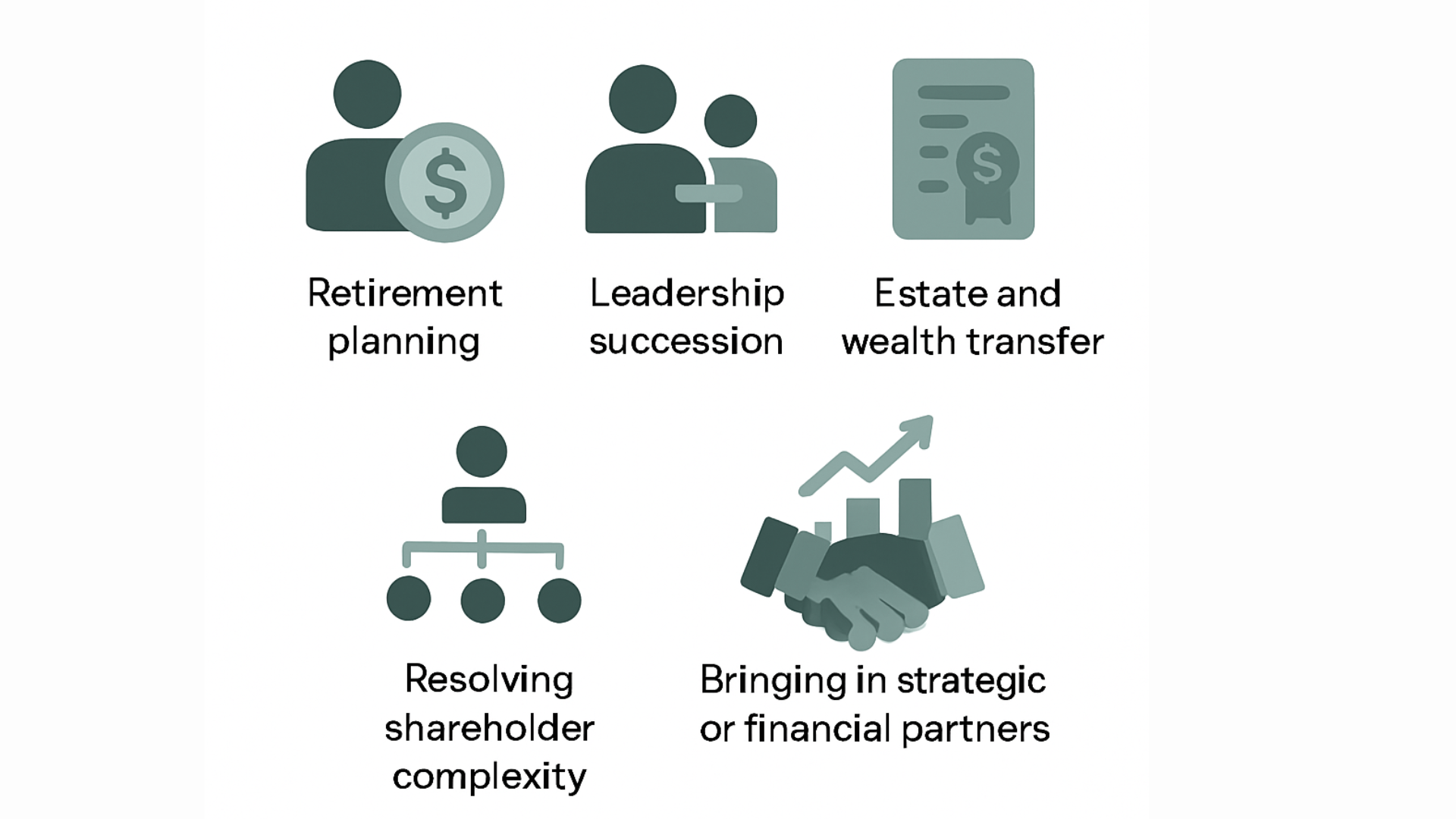
Retirement planning, leadership succession, or estate and wealth transfer goals
Resolving shareholder complexity, including diverging goals among family members or the desire of inactive owners to exit
Diversifying personal wealth that is heavily concentrated in a single illiquid asset
Bringing in a strategic or financial partner to accelerate growth, add operational expertise, fund acquisitions, facilitate geographic expansion, or capital investment
Understanding your primary motivation is the first step toward identifying the right transaction structure as well as the right team of advisors to help execute it.
The Most Common Types of Liquidity Events for Family-Owned Businesses
Once you have clarity on your goals, the next step is understanding which transaction structure best fits your situation. Each potential liquidity event carries distinct trade-offs around control, valuation, timing, and long-term operating flexibility. You’ll want to weigh your short- and long-term goals, timelines, current market conditions, your company’s financial health, and the needs of your shareholders. Without the necessary groundwork in place, you run the risk of unnecessary delays or worse, a failed deal.
Selling to Strategic Buyers or Private Equity Firms
Choosing to sell either a piece of your company or the whole thing remains the most common liquidity pathway for private companies. The most important variable in any sale process is not just valuation, but finding the right buyer for your business whose goals and culture align with yours. The two main types of buyers for family-owned or founder-led private companies are strategic partners and private equity or family office investors.
Strategic acquirers typically seek acquisitions for one of several reasons:
· Expanding to new markets or geographies
· Acquiring complementary products, services, or technology
· Gaining new operational capabilities, expanding operational scale, or eliminating a competitor
Accessing talent, management, or proprietary intellectual property
Private equity firms and family offices, by contrast, invest to accelerate growth and ultimately execute a future liquidity event.
Private equity partnerships have become increasingly attractive to family-owned businesses in recent years because they allow founders to monetize a portion of their ownership while retaining meaningful equity participation. This structure often creates a “second bite of the apple” opportunity when the PE-backed business is sold again in a larger liquidity event, hopefully at a higher valuation.
Key considerations when evaluating these transactions include:
Control and governance structure
Management retention and leadership succession
Growth capital availability
Long-term strategic alignment
Pro forma leverage
Owner risk tolerance
A sale of your business is one of the most consequential financial decisions of your life. Done well, it’s transformational and becomes the culmination of years of work. Done poorly, it is a missed opportunity.
Most founders only go through this process once, so we’ve compiled a multi-part series on Mergers and Acquisitions for Family Business Owners and Founders to help guide your process. At Keene Advisors, we combine deep investment banking and strategy experience with a lifetime of family business and entrepreneurial experience - this series distills what our team has learned advising on over $45 billion in successful mergers & acquisitions, capital raising, leveraged buyouts, and restructuring advisory experience.
Initial Public Offerings and Alternative Public Market Paths
An initial public offering (IPO) allows companies to raise capital and create shareholder liquidity through public equity markets. IPOs introduce significantly more regulatory complexity, shareholder transparency requirements, and pressure from equity analysts and institutional investors to meet quarterly and annual earnings expectations, which may not align with the long-term goals of a family-owned or founder-led business.
There are alternative public liquidity options, most notable direct listings and SPAC mergers although they typically require scale, infrastructure, and governance sophistication that many privately held businesses must prepare for years in advance. For most mid-sized family-owned companies, a public offering of any kind is a longer-range consideration that takes 18 - 24 months of dedicated preparation.
Secondary Market Opportunities
For private companies, secondary market transactions involve the sale of existing shares to new investors without the company issuing new equity. Unlike a full sale or an IPO, a secondary market transaction allows shareholders to achieve partial liquidity.
Secondary transactions can provide liquidity for early shareholders, retiring or inactive family owners, or allow a founding owner to reduce concentration while still maintaining operational control. However, secondary transactions must be carefully structured to address shareholder consent requirements, valuation, and long-term investor alignment.
Management Buyouts and Internal Ownership Transfers
Some owners prioritize continuity of leadership and company culture when pursuing a liquidity event. For these owners, internal transition strategies can offer a path to partial or full liquidity without introducing outside investors or new ownership that might disrupt operations or company culture.
Common internal liquidity structures include:
Employee Stock Ownership Plans (ESOPs), which allows employees to gain company ownership over time
Management buyouts, often financed through a mix of debt financing, institutional capital, and personal equity
Structured family ownership transfers, including gifting strategies and estate-planning vehicles
These transactions require careful financial engineering and succession planning but can be effective solutions for preserving business continuity, employee loyalty, and the founder or family-led culture.
Who Helps Private Companies with Liquidity Events?

Executing a liquidity event for a family-owned or founder-led business is rarely a solo endeavor. Engaging experienced advisors early in the process can significantly influence both the process and the outcome.
Investment Bankers and M&A Advisors
Investment bankers and M&A advisors help business owners:
Prioritize their goals and understand the range of liquidity options available
Develop a liquidity strategy or exit plan
Conduct valuation estimates and structure company positioning to prospective buyers or investors
In an M&A or external capital raise, run a competitive transaction process to maximize the company’s valuation and negotiate transaction terms and manage the closing process
In an IPO, assist in preparing the company for an IPO, select underwriters, auditors and issuers counsel.
Experienced advisors also help owners evaluate timing, market positioning, and investor appetite. These factors directly influence valuation and the likelihood of a successful transaction.
Legal and Tax Advisors
Legal and tax professionals play critical roles in transaction structuring, regulatory compliance, and estate planning. Their guidance often determines whether liquidity proceeds are optimized or unnecessarily eroded through avoidable tax exposure. Early engagement with the right legal and tax advisors can help the planning process significantly.
Wealth Advisors
Liquidity events often create transformational personal wealth outcomes for founders. Wealth advisors help owners design long-term financial strategies focused on diversification, preservation, and multigenerational planning.
Internal Leadership and Operational Advisors
Financial leadership teams and operational consultants help prepare businesses for institutional investor diligence by strengthening reporting infrastructure, improve financial controls, and optimize operational efficiency – all of which directly affect how prospective buyers will perceive and value the business.
Other Advisors

Depending on the liquidity pathway, additional advisors may be advisable. For example, companies contemplating an IPO may benefit from an IPO readiness assessment performed by an experienced public company audit firm like PwC, KPMG, EY or Deloitte. Companies contemplating a sale process or outside investment may benefit from a sell-side quality of earnings (“QofE”) report to identify EBITDA addbacks and valuation adjustments.
Preparing Your Business for a Successful Liquidity Event
Even the most attractive businesses can leave value on the table without adequate preparation. For family-owned and founder-led businesses in particular, the preparation phase often uncovers gaps in financial governance or shareholder alignment, which can be addressed and fixed before a transactional process begins.
Step 1: Strengthening Financial and Operational Readiness
Strategic and private equity buyers conduct rigorous due diligence during any transaction. Businesses that can demonstrate financial transparency and operational consistency will command a stronger valuation and have higher negotiating leverage.
Businesses should prioritize:
Understanding the key value drivers and KPIs that buyers evaluate, such as revenue predictability, margin growth, and customer diversification
Buyer/Investor-grade financial reporting, including audited or reviewed financial statements and documented finance and accounting procedures. For companies contemplating an IPO there are numerous financial, accounting, governance, and regulatory considerations to explore.
Governance and shareholder alignment that reduces transaction risk increases investor confidence
Keene strongly encourages our clients to invest time upfront in preparation and plays a crucial role in the preparation process. This means uncovering hidden value, identifying potential value traps, and anticipating the diligence an external buyer/investor will conduct so you can take proactive steps to ensure your company meets or exceeds that standard before the process of pursuing a liquidity event begins.
Step 2: Address Tax, Estate, and Legacy Planning
Liquidity transactions can have significant tax consequences, and the structure of a deal often matters as much as the headline price. Whether you’re planning for retirement, transferring ownership to a family member, or engaging in a sale where there is a transfer in majority ownership, working with a specialized tax advisor early in the process can help minimize your tax burden and inform other estate planning decisions.
Step 3: Acknowledge the Emotional Attachment
Family-owned businesses often represent personal identity, define community relationships, and build generational pride. Owners who treat the financial and emotional components as separate often underestimate how much the emotional complexity can affect decision-making and ultimately the outcome of the transaction.
Run through a full risk assessment that includes a candid accounting of family dynamics, diverging shareholder interests, and any personal hesitations so you can surface then address potential roadblocks early in the process.
Is a Liquidity Event Right for You?
With a clear understanding of the landscape surrounding preparing for and executing a liquidity event, owners and founders should engage in honest self-reflection before proceeding. Owners who lack clarity on their own goals – financial, operational, and personal – and their willingness to fully commit to the process, are least likely to have a successful outcome. A transaction process can move quickly, and ambivalence or wavering on the path forward can delay, complicate, or even derail even the most-favorable deals.
Before engaging initiating any process, business owners should be able to answer some key questions:
What financial outcomes do I need to achieve now and over the long run?
Do I want to maintain an active operational role after a transaction?
How important is family / employee ownership continuity to me and the other significant stakeholders?
Are current market conditions and valuation multiples aligned with my goals?
Is there demonstrated investor demand or interest in my industry or sector?
The answers to these questions won’t tell you the type of transaction to pursue, but they will guide your decisions on timing and what a successful outcome looks like. Advisors experienced with family-owned and founder-led companies, have seen many of these issues firsthand and can help you navigate your unique path.
Why You Need a Liquidity Plan
Most business owners who achieve optimal liquidity outcomes did not simply react to an opportunity when it arrived. Instead, they created the conditions for that opportunity years in advance. That’s why you need a liquidity plan today. A plan offers a strategic framework that aligns your business goals, personal goals, and family or life priorities long before a deal is ever on the table.
In the world of private company liquidity events, timing is rarely a matter of choice – it’s shaped by market cycles, business performance, family or founder circumstances, pressure from investors or other stakeholders, and the culture of the company itself. Owners who engage experienced advisors earlier in the process are able to unlock significantly greater flexibility, valuation potential, and structural efficiency.
Experienced capital advisors help family-owned and founder-led businesses:
Prioritize their goals and understand the full landscape of opportunities
Develop a comprehensive long-term liquidity strategy
Calculate a valuation framework that estimates what the business is worth today and develop a strategic plan to increase that value over the next three to five years
Coordinate an effort across business strategy, financial planning, tax and legal considerations, and governance to maximize operational efficiency
Counsel shareholders about transaction pathways that best fit their financial goals, liquidity timeline, and post-transaction intentions
At Keene Advisors, we believe liquidity planning should begin years, not months, before a transaction. Early strategic preparation allows owners to control timing, expand buyer competition, and strengthen negotiating leverage.
“The best time for a private company to plan for a liquidity event is three to five years before you need one.....the second-best time is today.”
The Cost of Waiting
For many family-owned and founder-led businesses, liquidity planning gets delayed indefinitely – crowded out by the daily demands of running the company. So when an event arises, whether an unsolicited acquisition offer, a health-event in the family, or liquidity pressure from early shareholders, owners are forced to make consequential decisions under pressure and a compressed timeline.
Don’t let that be you.
If you are considering your exit strategy, family succession planning, or have investor obligations that require access to more liquidity, contact the team at Keene Advisors today and let’s start the conversation. A liquidity plan doesn’t commit you to any particular outcome. It gives you clarity, preparation, and the flexibility to pursue the right outcome on your terms, rather than someone else’s.
Since our founding in 2015, Keene Advisors has been an independent partner for founders, family-owned businesses, and growth-oriented middle-market companies to develop and execute customized liquidity and capital strategies aligned with long-term goals and personal objectives.
Our team has advised clients on over $45 billion in corporate finance and M&A transactions, working directly with owners and key stakeholders to structure deals with favorable terms that align with their goals and needs.
If you are exploring a liquidity event, planning for succession in your family-owned business, or evaluating your long-term exit strategy, contact us today for a complementary consultation.