
Guide to Selling Your Family Business
Selling a family-owned business is one of the most consequential decisions a founder or family will ever make. The right investment banker does more than execute a transaction — they help you balance financial outcomes with strategic and personal priorities, including your legacy, your team, and the values your business was built on.
This guide walks you through what to look for, what questions to ask, and how to avoid the most common mistakes that cost family business owners millions.
Schedule a ConsultationPrepared by Travis Borden, Founder & President of Keene Advisors (updated June 2026).
Why Selling a Family Business Is Different
For most business owners, a sale is a financial transaction. For a family business owner, it is something far more complex. The business may represent decades of sacrifice, a parent's life work, a sibling's livelihood, or the foundation of an entire family's identity. The decision to sell is rarely just about the money - and the advisors who treat it that way almost always fall short.
Understanding what makes family business transactions genuinely different is the first step toward navigating them successfully.
Emotional & Legacy Considerations
Identity and Legacy
For many family business owners, the business is inseparable from their personal identity. Letting go can feel like losing a part of themselves. A thoughtful advisor helps owners separate their personal legacy from the transaction, and find deal structures that honor both.
The Weight of the Family's Decision
Family members often carry an enormous sense of responsibility - to employees who have given years of their career, to customers, to communities. Choosing the right buyer is not just a negotiation; it is a values decision about who will carry the business forward.
Employee and Community Impact
Unlike institutional sellers, family business owners often know their employees by name. The concern about what happens to those people after a sale is real and legitimate - and the right advisor structures processes and buyer conversations that address it directly.
Timing and Emotional Readiness
Financial readiness and emotional readiness rarely arrive at the same time. Starting conversations early - well before a decision is final - gives owners the space to process both dimensions and approach the transaction from a position of clarity rather than urgency.
Purpose Beyond the Transaction
Many family business owners define success not by the price they receive, but by what the proceeds allow them to do - fund retirement, support the next generation, establish a foundation, or reinvest in a new venture. Defining what success looks like before the process begins is essential.
Confidentiality and Reputation
For family businesses embedded in their communities, the mere perception that a sale is underway can affect employee morale, customer relationships, and supplier confidence. A well-managed process maintains confidentiality at every stage until the timing is right.
Managing Differing Priorities Across Family Members
One of the most underestimated challenges in a family business sale is that not every family member starts from the same place. Some rely on the business for income. Some are emotionally attached to it. Some are ready to sell; others are not. These differences - across siblings, cousins, and generations - can create significant tension if they are not addressed openly and early.
Family members who work in the business often have a fundamentally different perspective than those who hold equity but are not involved day to day. Their financial needs, timelines, and emotional connections to the outcome can differ significantly.
Senior family members may prioritize legacy and continuity; younger generations may be more focused on liquidity or growth. Bridging these perspectives requires patient, facilitated conversations - ideally before the formal sale process begins.
Extended family ownership structures - across siblings, cousins, or multiple branches of a family - can introduce competing financial needs and deeply held views about what the business means. A skilled advisor helps surface and align these perspectives before they surface at the negotiating table.
What Family Business Owners Should Look For
Not all M&A advisors are the same. For family-owned businesses, the most important factors go beyond credentials and deal volume. You need an advisor who understands that your goals are financial, strategic and personal - and who will advocate for all three.
Family Business Expertise
Look for advisors who specialize in private, founder-led, and family-owned companies — not those who primarily serve public companies or large corporations.
Independence
An independent firm has no conflicts of interest. Large banks often have financing, lending, or advisory relationships with potential buyers — creating misaligned incentives.
Senior Attention
At many large banks, senior bankers win the business and junior analysts execute the work. Make sure you know exactly who will be advising you throughout the process.
Holistic Perspective
The right advisor understands that a successful outcome means more than the highest price — it includes your legacy, your employees, and your values.
Proven Track Record
Ask for specific examples of transactions like yours. Results matter. Look for advisors with significant transaction experience who understand the nuances of family business M&A.
Process Discipline
A competitive, well-run process is the single most reliable way to maximize value. Ask how the firm structures its sale process and how many buyers they typically approach.
Investment Banker vs. Business Broker: What's the Difference?
Many owners don't realize there is a meaningful difference. Business brokers typically handle smaller transactions (under $5M) and focus on matching buyers and sellers. Investment bankers run a structured, competitive process to maximize value, advise on deal structure, and navigate complex negotiations — especially critical for family-owned businesses where the stakes extend beyond price.
Investment Banker
Business Broker
Questions to Ask Before Hiring an Investment Banker
The right questions reveal whether a firm is truly equipped to serve your needs — or simply telling you what you want to hear.
Have you closed transactions for family-owned businesses like mine?
Look for specific, relevant examples — not just deal volume. A firm with deep family business experience understands the unique dynamics, emotional considerations, and legacy goals that matter most to owners like you.
Who will actually be working on my transaction day to day?
At large banks, senior bankers often hand off execution to junior analysts. You want to know exactly who will be at the table throughout - from pitching to closing.
How do you run a sale process, and how many buyers will you approach?
A competitive process - approaching multiple qualified buyers simultaneously - is consistently the most effective way to maximize value and terms. Ask for a specific process overview.
Do you have any conflicts of interest with potential buyers?
Large banks often have lending, advisory, or ownership relationships with potential acquirers. An independent advisor has no such conflicts - their only priority is your outcome.
How do you think about deal structure, not just price?
Earnouts, rollover equity, reps and warranties, and tax treatment can meaningfully change what you actually walk away with. Your advisor should be deeply fluent in deal structure - not just headline valuation.
How do you incorporate non-financial priorities into the process?
For family business owners, a successful outcome often includes preserving culture, protecting employees, and honoring legacy. Ask how the firm incorporates these priorities into buyer selection and negotiation.
Common Mistakes That Reduce Valuation
Most value is lost before the process even begins. These are the patterns we see most often — and they are all avoidable with the right preparation and advice.
Going to market unprepared
Unaddressed red flags — declining margins, customer concentration, inconsistent financials — hand buyers leverage and erode your price before negotiations even begin.
Accepting the first offer
The first offer is rarely the best. A competitive process with multiple qualified buyers consistently produces superior outcomes compared to a bilateral negotiation.
Focusing only on headline price
Earnouts, rollover equity, reps & warranties, and tax treatment can materially change what you actually walk away with at close. Structure matters as much as price.
How Keene Advisors Can Help
Independent Investment Banking Built for Family Business Owners
Keene Advisors is an independent investment bank and strategy advisory firm built exclusively for private, founder-led, and family-owned businesses. We combine deep transaction expertise with a lifetime of family business experience - providing our clients with advice for both the financial and personal dimensions of a business sale.
We take a different approach. Our engagements are structured to align with clients' holistic needs - financial, strategic, and personal - ensuring honest advice and outcomes that reflect what success truly means to you.
Selling a family-owned business is one of the most consequential decisions a family can make. This guide explains every stage of the journey, from defining a successful outcome, to understanding how buyers will value the business, and the steps can be taken to maximize that value before going to market.
Gain the confidence to reach a deal that honors your family legacy and sets up future generations for success.
Download Our Free Guide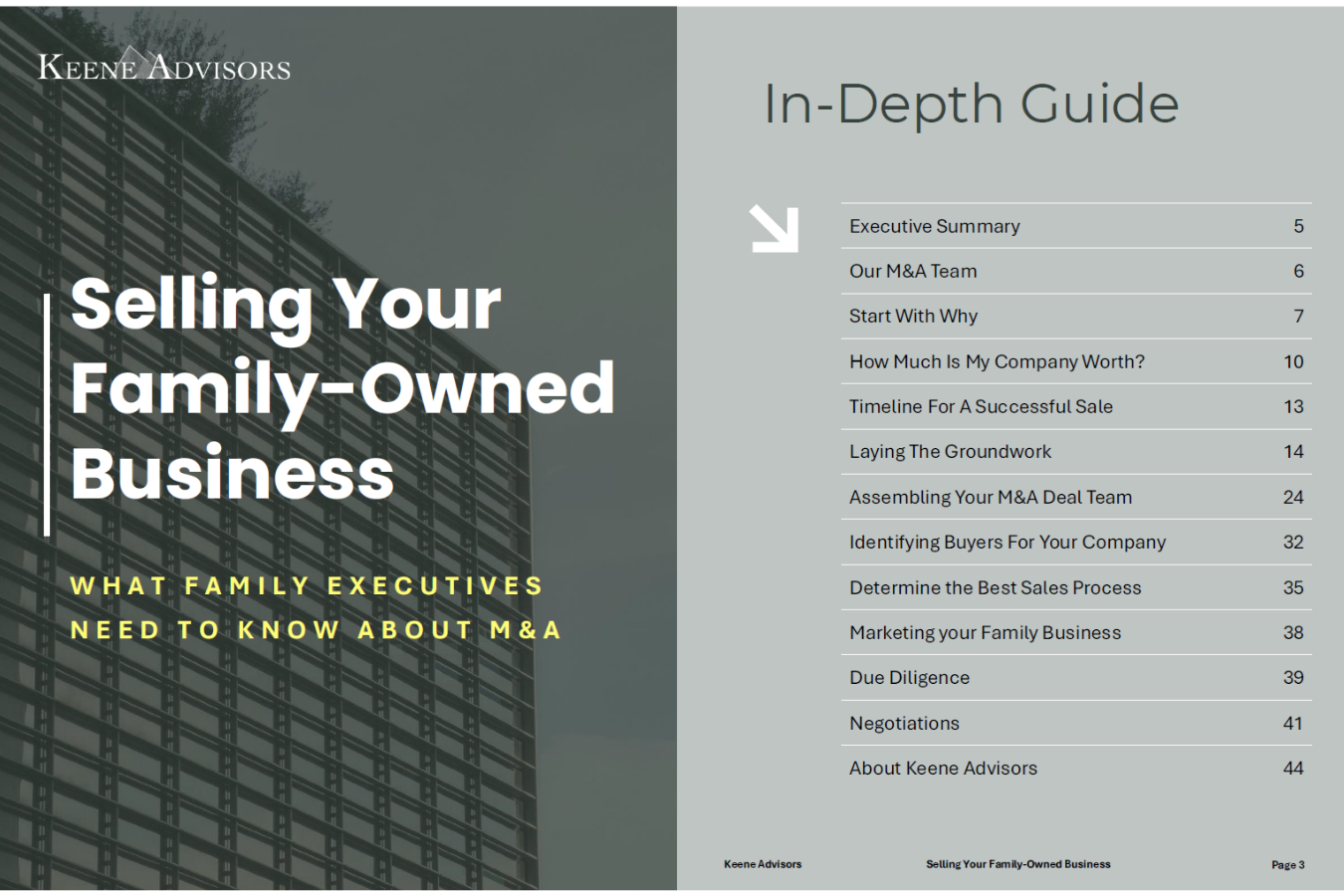
Ready to explore your options?
Schedule a confidential complimentary consultation with a senior member of our team.
Schedule a ConsultationCommon Questions About Selling Your Business
How do I find the right investment banker to sell my business?
The best way to find an investment banker is to evaluate firms based on their experience with similar transactions, their ability to run a competitive sale process, and their understanding of family business dynamics. Business owners should speak with multiple advisors, ask for relevant deal examples, and assess whether the firm understands both the financial and personal goals behind the sale.
Do I need an investment banker or a business broker?
Investment bankers typically work with mid-sized and larger businesses and focus on maximizing valuation through a structured M&A process, while business brokers are more common for smaller transactions. If your company has meaningful scale or complexity, an investment banker can run a competitive process, access a broader set of buyers, and negotiate more favorable terms.
What does an investment banker actually do when selling a business?
An investment banker manages the entire sale process, including valuing the business, preparing marketing materials, identifying and contacting potential buyers, coordinating due diligence, and negotiating deal terms. Their role is to create competition among buyers and ensure the business achieves the best possible outcome.
How long does it take to sell a business?
Sale processes can be completed as quickly as 4 months but can take 12 months or more, depending on the size, complexity, and market conditions. The process typically involves preparation, buyer outreach, negotiations, and closing. Proper preparation early on can significantly improve both timeline and outcome.
How much does it cost to hire an investment banker?
Investment bankers are either compensated through a combination of a monthly retainer and a success fee based on the final transaction value or based on an hourly bill rate and success fee. While fees vary, many business owners find that a well-run process increases the final sale price enough to more than offset the cost.
Will an investment banker increase the value of my business?
In many cases, yes. By running a structured, competitive process and reaching a broad set of qualified buyers, investment bankers can help increase valuation and improve deal terms. Studies and market data suggest that working with an experienced advisor can lead to a meaningfully higher outcome compared to a direct negotiation.
When is the right time to start talking to an investment banker?
Ideally, business owners should begin discussions 1–3 years before a potential sale. Early engagement allows time to improve financial performance, address risks, and position the business more effectively, all of which can have a significant impact on valuation. Check if the investment bank has sale preparation services and can help you begin the preparation process before engaging them for the full sale process.
What should I look for in an investment banker for a family-owned business?
For family-owned businesses, it's important to choose an advisor who understands both financial objectives and non-financial priorities such as legacy, employee continuity, and family dynamics. Experience working with founder-led or multi-generational businesses is often a key differentiator.
How is selling a family-owned business different from other transactions?
Selling a family-owned business often involves more than just financial considerations. Owners must balance valuation with legacy, employee impact, and long-term family goals. The right advisor helps navigate both the technical aspects of the transaction and the emotional complexity involved.
Can I sell my business without an investment banker?
While it is possible to sell a business independently, many owners find the process challenging due to its complexity and the demands it places on their time. Without an advisor, it can be difficult to create competitive tension among buyers or negotiate optimal terms, which may result in a lower outcome.
How do investment bankers find buyers for my business?
Investment bankers develop a targeted list of potential buyers that may include strategic acquirers, private equity firms, and family offices. They leverage industry knowledge, relationships, and proprietary research to create a competitive process that maximizes interest and valuation.
What mistakes should I avoid when choosing an advisor?
Common mistakes include selecting an advisor based solely on price, failing to assess relevant deal experience, and not verifying how actively senior team members will be involved. It is also important to ensure alignment on goals, communication style, and expectations. A successful sale process requires trust and strong collaboration. Make sure your investment banker is trustworthy and assess whether they will be a good collaborator.
How does Keene Advisors help business owners sell their companies?
Keene Advisors works with private, founder-led, and family-owned businesses to manage the entire sale process from initial planning through closing. The firm combines investment banking expertise with strategic advisory capabilities to help owners maximize value while preserving what matters most to them.
What makes Keene Advisors different from other investment banks?
Keene Advisors focuses specifically on private and family-owned businesses, combining deep transaction experience with an understanding of the unique dynamics these companies face. This allows the firm to provide advice that is not only financially sound but also aligned with long-term legacy and ownership objectives.
About Keene
We are an independent investment bank and strategy advisory firm built for private, founder, and family-owned businesses. Our team has advised on over 200 investment banking and strategy engagements over the last 25 years, including over $45 billion in M&A, Capital Raising and Restructuring Advisory transactions. We combine deep investment banking and strategy experience with a lifetime of family business and entrepreneurial experience.
