
3 Critical Steps: Building a Shareholder Liquidity Strategy for Private Family-Owned Businesses
Key Takeaways:

A proactive liquidity strategy requires a rigorous process that includes financial modeling, governance design, capital structure analysis, and thoughtful liquidity event planning.
Shareholder liquidity planning is most effective when it begins well before a transaction is necessary. Owners who wait until pressure becomes urgent often face constrained options, compressed timelines, and potentially avoidable costs.
Working with experienced advisors increases the chance that you’ve evaluated all of your liquidity options and chosen the structure that best suits your company and its shareholders.
How to Build a Shareholder Liquidity Strategy for Private Family-Owned Businesses
For owners of private family-owned, and founder-led companies, decisions on when and how to provide liquidity to shareholders are among the most sensitive and strategically important they will make. Yet, they are often deferred due to complexity, competing priorities, and uncertainty about where to begin.
Handled well, a shareholder liquidity strategy allows owners to diversify wealth, fund personal retirement, manage estate obligations, and reduce concentration risk without compromising the business. Handled poorly, it can strain cash flow, increase leverage, trigger shareholder conflicts, and erode long-term enterprise value.
Over many years, Keene Advisors has advised private companies and multi-generational family businesses on shareholder liquidity planning, and the most successful outcomes share a common characteristic: liquidity is treated as an ongoing capital strategy, not just a one-time transaction.
Below, we outline why developing a shareholder liquidity strategy matters for all private business owners, what typically drives these conversations, and share the first three steps of a structured framework for building a durable shareholder liquidity strategy that protects the business and its owners.
Shareholder Liquidity Doesn’t Start or End with a Liquidity Event

Specific corporate liquidity events are widely discussed, but they are often misunderstood as the entirety of a liquidity strategy rather than one component within it. For private family-owned and founder-led businesses, the bigger question is not whether a liquidity event will eventually occur (it usually does) it’s whether the business and its owners are prepared when the time is right.
What Is Shareholder Liquidity?
Shareholder liquidity refers to the ability of shareholders to convert equity in a private company into cash or other realizable value – ideally through a structured, planned process that does not impair the company's long-term financial health or operational continuity.
For public companies, shareholders can sell their shares on an exchange at virtually any time. Private company shareholders cannot. That fundamental difference is the source of the majority of the complexity that will be addressed throughout this article.
In private family-owned businesses, a shareholder liquidity strategy must be deliberately engineered to balance the potentially competing needs of operating shareholders, inactive family members or other owners, and the business itself.
What Is a Liquidity Event?
A liquidity event is a transaction that enables one or more shareholders to convert illiquid ownership into cash or other realizable value.
Examples include:
Sale of the company to a strategic buyer
Sale to or partnership with a private equity firm or family office investor
Initial public offering (IPO)
Tender offer or structured secondary sale
Company-funded share redemption
Dividend recapitalization
The right option, or combination of options, will depend on your company’s size, growth trajectory, cash flow characteristics, and the long-term objectives of both the business and its shareholders.
It’s important to recognize that these events are tools, not strategies in themselves. Effective liquidity planning should begin well before any transaction becomes necessary. Owners who wait until liquidity pressure becomes urgent often find their options significantly constrained.
Why Private Family-Owned Businesses Face Unique Liquidity Challenges
Unlike publicly-traded companies where shareholders can sell their shares freely on a stock exchange, private company owners face a structurally different set of constraints:
Ownership stakes are inherently illiquid
A founder or family-member’s wealth is often concentrated within their company ownership
Shareholder bases may span multiple generations with diverging financial needs
Private companies have limited access to secondary markets
Emotional attachment, legacy considerations, and family governance dynamics add complexity that’s not present in most other corporate ownership structures
Over time, ownership often becomes more fragmented and complicated, often without the ongoing governance infrastructure necessary to manage diverging interests. Inactive shareholders may need cash for retirement or estate taxes. Operating shareholders may prefer to reinvest in growing the business for the future. Without a structured liquidity strategy, these competing priorities can escalate into governance conflicts or force poorly-timed transactions.
Generational Transitions and Succession Planning
For many family-owned businesses, the most consequential liquidity conversation is not triggered by a desire to sell, but rather by the reality of succession. When a founder begins stepping back from day-to-day leadership, or when ownership is set to transfer to the next generation, the financial and governance questions that may have been deferred for years become immediately pressing.
That transition rarely unfolds cleanly. As ownership passes from founders to second- and third-generation shareholders, several dynamics tend to compound simultaneously:

The shareholder base expands, often including family members with no operational role in the business
Voting control may become diluted or contested across family branches
Risk tolerance and liquidity preferences diverge among multi-generational owners: some may want to reinvest and grow the business while others may want to exit
Estate tax exposure increases as enterprise value grows, sometimes creating liquidity needs that are time-sensitive
These dynamics intersect with personal relationships and legacy considerations in ways that purely financial frameworks cannot resolve on their own. A successor who lacks the capital to buy out departing family members, or a family that lacks a clear process for valuing and transferring shares, can find a well-run business destabilized by the absence of liquidity planning.
Governance structures, buy-sell agreements, and shareholder liquidity provisions should be established well before a transition is imminent. Ideally, these are a standing part of the company's ownership strategy, not as a response to a triggering event.
Founder Retirement and Wealth Diversification
An estimated 70-80% of founders have most of their net worth tied up in their company. That level of concentration can represent significant personal financial risk and liquidity planning can provide a much-needed path to gradual diversification. It’s most effective when balanced against:
The owner’s desired level of ongoing operational involvement
The company’s debt capacity and ability to support additional leverage
Ongoing capital needs of the business
For many founders, the prospect of an ownership transition from a business they have spent many years building can carry emotional weight and letting go can be daunting. A well-structured liquidity plan allows owners to de-risk gradually rather than forcing a full exit.
Employee Equity Can Trigger Liquidity Needs
Venture backed private companies increasingly grant equity compensation to key employees as a retention and incentive tool. As IPO timelines have gradually lengthened over the past decade, with the median time from first funding to IPO reaching 7.5 years, employees holding equity face extended periods with no mechanism to realize any tangible value from their ownership.
During that time, pressure often builds for interim liquidity solutions, which may include:
Company-sponsored tender offers
Structured secondary transactions arranged by the company
Prespecified liquidity windows that allow stock sales within a defined framework
Similar pressures can confront family-owned companies with non-family minority shareholders. These owners should consider similar mechanisms if outside shareholders approach the company with liquidity expectations.
Capital Structure and Growth Strategy Alignment
Shareholder liquidity does not exist in isolation – it is closely intertwined with the capital a business wants to reinvest to fund growth, service debt, and maintain financial resilience. As your company grows, aligning the liquidity strategy with the overall capital structure becomes increasingly important.
Distributing too much capital to shareholders can:
Constrain the company’s ability to fund organic growth or acquisitions
Increase leverage to levels that reduce financial flexibility
Reduce the business’s resilience in an economic downturn
Conversely, consistently deferring shareholder liquidity can create misalignment between a company’s leadership and its shareholders, increasing governance risk over time.
3 Key Steps to Building a Shareholder Liquidity Strategy
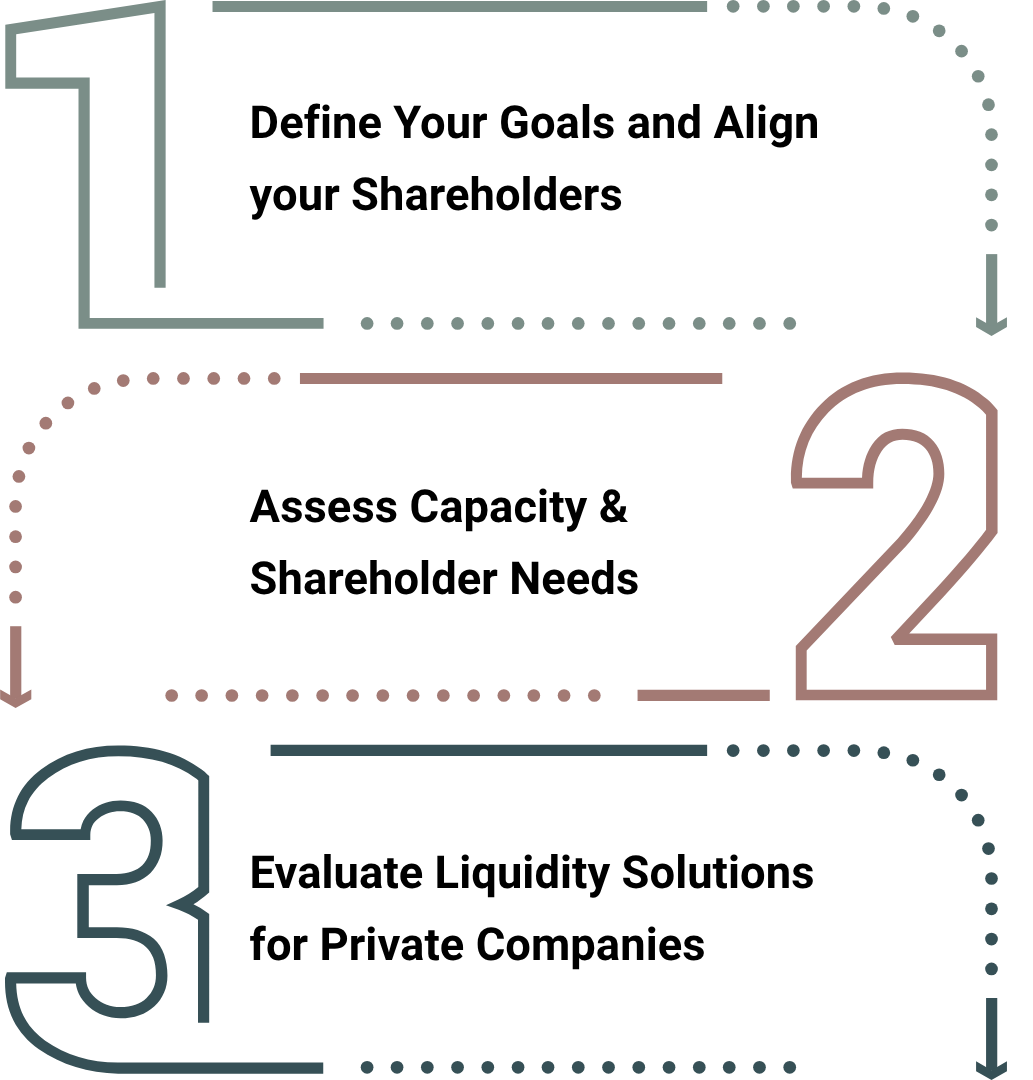
Step 1: Define Your Goals and Align your Shareholders
No liquidity strategy can succeed without first establishing clarity on why liquidity is needed, by whom, and within what timeframe. Leadership must align on the principles and goals that are driving these conversations, and this exercise should be done in collaboration with shareholders. Diverging expectations that are left unaddressed at this stage will most likely surface as friction later in the process.
Common Reasons Shareholders Need Liquidity
In an ideal world, enterprise and shareholder goals would align; however, that’s not always the case. That divergence is rarely apparent until a liquidity conversation forces the discussion. Understanding each shareholder's liquidity objectives, timeline, and contractual rights is essential to anticipating potential needs and liquidity triggers.
Common shareholder liquidity motivations include:
Founder or CEO succession or retirement
Resolution of shareholder disputes or ownership conflicts
Providing liquidity for employee equity holders
Buying out passive or inactive shareholders
Satisfying the liquidity expectations of institutional investors or other outside shareholders
Diversification of personal or family wealth
Reducing pressure for a full exit, IPO, or sale
Estate planning and tax management
Long-term governance planning and ownership simplification
The company’s objectives and the shareholders’ goals aren’t always in conflict - with transparency and regular dialogue, many owners find they're more closely aligned than previously thought. A disciplined liquidity framework creates the space to have constructive alignment conversations.
Step 2: Assess Capacity & Shareholder Needs
Once goals are defined, the next step is understanding what is feasible. This step requires two components: a clear-eyed assessment of which shareholders need liquidity and when, and a rigorous analysis of the business’ capacity to support it.
This analysis should extend beyond basic forecasting to include the impact on the company’s capital structure, leverage tolerance, debt service capacity, covenant flexibility, and long-term strategic investment requirements.
Estimating the Value of Shares Requiring Liquidity
The starting point for a liquidity capacity analysis is a credible valuation of the business. That valuation should be grounded in the company’s long-term plan and informed by both intrinsic approaches (such as discounted cash flow analysis) and relative approaches (such as comparable company analysis and precedent transactions). Engaging a qualified investment banker helps ensurethe estimates are realistic and defensible, which in turn directly influences the liquidity options available to your business.
PRACTICE NOTE: A viable liquidity program requires a defensible valuation. The valuation of the business should be objective, based on high-quality current data, and provide transparent methodology. For most privately held businesses, this means engaging an independent third-party valuation firm rather than relying on internal estimates. Independent valuations reduce the risk of disputes among shareholders and provide a credible basis for negotiation with outside parties.
Cash Flow and Scenario Modeling
To determine whether your company can support shareholder liquidity needs through internally generated cash flow or existing credit facility capacity, leadership should develop a dynamic three-statement model that includes P&L, balance sheet, and cash flow projections under multiple scenarios.
Conduct a thorough and deep analysis, including but not limited to:
Base case: current financial projections
Growth case: upside potential with assumptions tied to the performance of strategic initiatives
Downside stress tests: adverse scenarios including an economic downturn or loss of a major customer
Model the impact of potential liquidity distributions under each scenario to ensure adequate reserves remain for operations, debt servicing, and capital expenditures.
Step 3: Evaluate Liquidity Solutions for Private Companies
With goals defined, and capacity assessed, the next step is identifying liquidity structures that are actually available to your business.
There is not a specific right answer, but rather the appropriate solution will depend on your company’s size, growth profile, cash flow characteristics, and the degree of control and continuity you want to preserve.
A key part of this stage in the evaluation is a firm understanding of each liquidity structure’s benefits and disadvantages, weighed against your key objectives. For example, some structures dilute ownership, others add leverage, while others limit your flexibility for a future transaction.
An experienced advisor will help you map these options against your specific objectives and identify the structure, or combination of structures, that best position your company and shareholders for the long-term.
Liquidity Solutions for Private Companies
| Company-Funded Solutions | Private Market Solutions | Public Market Solutions |
|---|---|---|
| Company-Funded Tender Offer(s) | Investor-Funded Tender Offer | Initial Public Offering (IPO) |
| Dividend Recapitalization / Special One-Time Dividend | Private Secondary Market Listing | |
| Regular Dividend Program |
Company-Funded Solutions
Companies can elect to self-fund shareholder liquidity internally through a variety of one-time or ongoing methods, without bringing in outside investors, or triggering an ownership change.
Company-Funded Tender Offer(s)
The company offers to purchase shares from existing shareholders at a fixed price during a defined window. Shareholders who elect to participate receive cash in exchange for a proportion of their shares; those who don’t may see their ownership percentage increase as the total number of shares outstanding decreases. The tender offer can be funded with cash or debt financing.
Dividend Recapitalization / Special One-Time Dividend
Even if your company does not offer an ongoing dividend program, the company can still elect to distribute a one-time dividend to all shareholders. No shares are redeemed, and relative ownership percentages remain unchanged. This can be funded with cash or debt and is an effective mechanism for providing partial liquidity without altering the ownership structure.
Regular Dividend Program
The company establishes a formal dividend policy that distributes a portion of earnings to all shareholders on a recurring basis, usually quarterly or annually. Divided policies generally require board approval, ongoing evaluation relative to business performance, and careful management to avoid creating a dividend expectation that the company can’t consistently meet.
Private Market Solutions
Private market solutions involve bringing in outside investors to purchase shares directly from existing shareholders, without the company being sold outright. These types of transactions are particularly relevant for companies with dispersed ownership, significant employee equity, or shareholders who need liquidity ahead of a planned future exit.
Investor-Funded Tender Offer
In these strategic transactions, a third-party investor, such as a private equity firm or family office purchases a meaningful percentage of shares directly from shareholders in a structured transaction. Often, these transactions involve raising additional growth capital alongside the liquidity component, which can make them attractive to companies that want to accomplish both objectives simultaneously.
Private Secondary Market Listing
The company arranges for its shares to be listed on a private secondary platform such as a specialized private exchange, allowing shareholders to transact directly with qualified buyers. The company typically retains a Right of First Refusal (ROFR), which may help it retain a degree of control and preserve ownership rights and stability.
Public Market Solutions
Public markets transactions represent the most comprehensive and most demanding form of providing shareholder liquidity. They require extensive financial preparation, regulatory and accounting compliance, and a years-long commitment to building the necessary governance structure.
Initial Public Offering (IPO)
An initial public offering (IPO) involves listing the company’s shares on a public exchange, creating an ongoing public market for the purchase and sale of company shares. Existing shareholders can elect to sell a portion of their holdings during the IPO (as a secondary share offering) or in the open market following the completion of any applicable lock-up period.
M&A: Strategic Sale or Private Equity Partnership
A sale to a strategic acquirer or private equity firm / family office can provide complete or partial liquidity, depending on the structure. Strategic sales typically offer a full exit at a negotiated enterprise value. Private equity and family office transactions, often structured as leveraged buyouts (LBOs), typically allow active shareholders / founders to retain a meaningful equity stake, creating the opportunity for a second liquidity event in the future, when the PE firm or family office ultimately exits their investment.
Employee Stock Ownership Plan (ESOP)
An Employee Stock Ownership Plan (ESOP) is a structure that enables a company to transition ownership to its employees over time. It provides employees with an opportunity to participate in ownership of the company, aligning their incentives with the company's long-term performance.
Why Experienced Advisors are Essential to Developing and Executing a Shareholder Liquidity Strategy
Shareholder liquidity planning is not a process most family-owned or founder-led businesses navigate more than once or twice in their career. The stakes (financial, relational, and operational) are high, and the margin for error is small. Liquidity transactions typically require a coordinated team that may include investment bankers, valuation specialists, tax advisors, legal counsel, and wealth advisors – each playing a critical role in structuring, pricing, and executing the transaction.
Working with experienced advisors can also help business owners avoid the most common and costly pitfalls, such as waiting until liquidity pressure becomes urgent, overleveraging the business to satisfy short-term shareholder demands, or entering a process without a clear view of the structural or operational implications.
What Differentiates Leading Advisory Firms
Not all advisory firms are equally equipped to serve family-owned and founder-led businesses. When evaluating potential partners, prioritize demonstrated capabilities and depth of experience.
The advisory firms best suited to work with your company will distinguish themselves through:
Deep experience with the governance and ownership dynamics of private family-owned and founder-led businesses
Integrated transaction structuring and capital markets expertise
Independent, rigorous valuation capability
Cross-disciplinary expertise and proven ability to coordinate across financial, legal, and personal wealth considerations
A long-term orientation toward maximizing enterprise value for the company and its shareholders
Liquidity decisions permanently reshape ownership structures and financial outcomes. The partner(s) you choose to guide that process should have both the experience and independence to prioritize your best interests throughout.
Conclusion: Turning Shareholder Liquidity into a Strategic Advantage
For family-owned and founder-led businesses, the question is rarely whether shareholder liquidity will eventually become a priority – most likely it will. It’s whether you’ll be positioned to address it proactively or be forced to react to external pressure.
When approached with discipline, a thorough shareholder liquidity framework becomes a stabilizing force rather than a disruptive one. A strategy grounded in comprehensive financial modeling, governance design, capital structure analysis, and thoughtful planning increases the likelihood of an outcome that meets the needs of both the business and its shareholders, without forcing conflict between the two.
Owners who treat liquidity as part of a long-term capital strategy are better positioned to:
Support generational ownership transitions without governance disruption
Preserve and grow enterprise value over time
Maintain financial resilience
Deliver fair, transparent outcomes for all shareholders
At Keene Advisors, we work with private family-owned and founder-led companies to develop and execute customized liquidity and capital strategies aligned with long-term business and personal objectives. We’re an independent investment bank and strategy consulting firm built to serve private, founder-led, and family-owned companies. Our focus and experience gives us a deep appreciation for the unique dynamics that drive private, family-owned and mission-driven enterprises.
With hundreds of successful client engagements and experience advising on over $45 billion in mergers & acquisitions (M&A), capital raising, and restructuring transactions, our team brings unparalleled insights and a proven track record of success to our clients.
If you are exploring shareholder liquidity options and need a strategy backed by experience and a deep commitment to independence, contact us today for a complimentary consultation.
About Keene Advisors
Strategic and Financial Advice, Global Impact
Keene Advisors is an independent investment bank and strategy consulting firm built to serve private, founder-led, and family-owned companies. Our focus and experience gives us a deep appreciation for the unique dynamics that drive private, family-owned, and mission-driven enterprises.
With hundreds of successful client engagements, and experience advising on over $45 billion in mergers & acquisitions (M&A), capital raising, and restructuring transactions, our team brings unparalleled insights and a proven track record of success to our clients.